
Milestone
All 95 foundations installed at East Anglia THREE windfarm
By Staff Writer | 17 August 2026
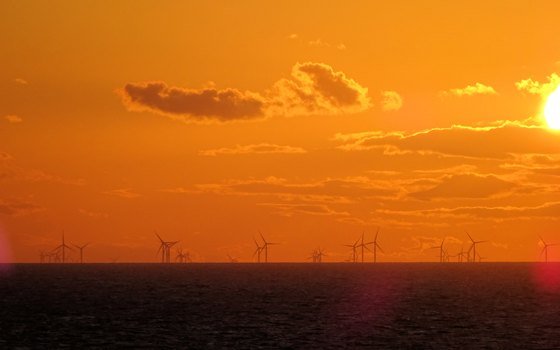
ScottishPower Renewables and Masdar have completed the foundation installation campaign at the 4 billion pound East Anglia THREE offshore windfarm, with all 95 monopiles and all 95 transition pieces now in place off the Suffolk coast.
The milestone was announced on 17 August 2026. The monopiles weigh between 1,200 and 1,800 tonnes, stand 67 to 84 metres tall and have a diameter of up to 10.6 metres. The developers state that they are the largest to be installed from a jack-up vessel in Europe.
The 95 transition pieces, the sections that connect the monopile to the turbine tower, are 20 metres in height, 8 metres in diameter and weigh more than 400 tonnes each. The foundation installation was delivered by Seaway7, and East Anglia THREE was the first foundation installation campaign completed by its jack-up vessel Seaway Ventus.
Turbine installation is already under way. Offshore and onshore construction continues over the coming months, with the windfarm expected to be fully operational by the end of 2026 and to deliver 1.4GW.
The completion of foundation installation at East Anglia THREE is a significant milestone and a remarkable engineering achievement. It reflects the strength of our partnership with ScottishPower and the expertise of the project team and contractors, particularly Seaway7, who are working together to deliver one of the UK's largest offshore wind farms.
Husain Al Meer, Executive Director, Global Offshore Wind and UK, Masdar
East Anglia THREE is our biggest windfarm ever and the completion of the foundation installation is a true engineering triumph. You only have to look at the numbers, more than 200,000 tonnes of steel anchored spot on into a seabed area the size of almost 43,000 football pitches, to get a sense of what we've achieved so far.
Charlie Jordan, Chief Executive, ScottishPower Renewables
With the foundations now in place, Seaway7 continues to progress the installation of inter-array cables to bring East Anglia THREE another step closer to delivering clean, reliable power.
Lloyd Duthie, Chief Executive, Seaway7
The project is a 50:50 joint venture and is the second developed under the Masdar and Iberdrola strategic partnership, and the first with ScottishPower in the United Kingdom. The developers state that almost 2 billion pounds has been invested in the domestic supply chain.
What the practitioner should take from this
Foundation installation is the campaign on which every later offshore workstream depends, and it is priced by the day. A jack-up vessel on a foundation campaign is the single most expensive item on the programme, so the contract's weather downtime allocation decides who pays when the sea state exceeds the operating limit. Practitioners should look for the workable weather criteria stated as numbers, wave height limits, wind speed at hub height, the duration of the window required for each lift, and for a baseline against which actual conditions can be measured. Where the criteria are qualitative, the argument at the end of the campaign becomes a battle of expert reconstruction rather than a comparison against an agreed figure.
The transition from foundations to inter-array cabling is the interface worth watching on a project of this shape. Cable installation cannot start at a position until the foundation is in and accepted, and turbine installation cannot start until the transition piece is set. Where those three campaigns are let to different contractors, or run by different parts of the same organisation, the sequencing obligations and the access dates between them carry most of the delay risk. A completion certificate for one campaign is not the same thing as readiness for the next, and the contract should say which of the two triggers the follower's access date.
A stated operational date at the end of the same calendar year as the foundation completion also concentrates the commercial pressure on acceptance testing. Grid connection dates, subsidy contract milestones and turbine warranties usually run to fixed dates rather than to progress, so any slippage lands on the last activity in the chain. Where a project reports itself on course for an end of year date, the practical question is what happens to the commissioning window if it is not, and whose obligation absorbs it.
Nothing here indicates a dispute on this project. It is the ordinary commercial anatomy of a large offshore campaign: vessel day rates, weather criteria and interfaces between successive marine workstreams.