
World News
A flagship space telescope launches, and its owner says it was delivered ahead of schedule and on budget
By Staff Writer | 31 August 2026
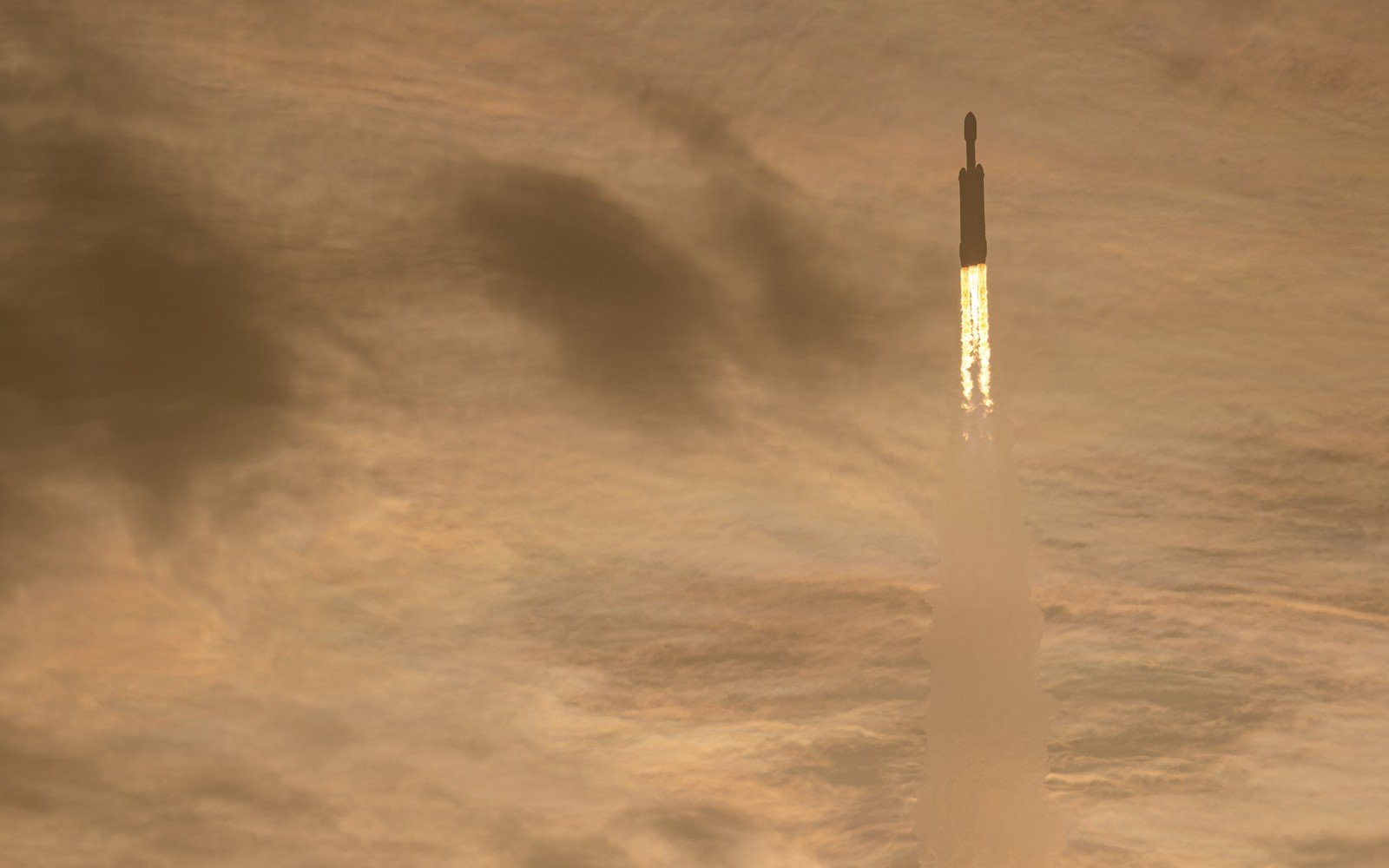
The Nancy Grace Roman Space Telescope left Launch Complex 39A on Sunday morning on a Falcon Heavy. The first thing the agency's administrator said about it in the official release was about delivery and cost, not astronomy.
A wide field infrared observatory built to survey billions of stars and galaxies lifted off at 7:26 a.m. Eastern on Sunday 30 August, aboard a SpaceX Falcon Heavy from Launch Complex 39A at the Kennedy Space Center in Florida. It is now on a journey of about three months to the second Sun-Earth Lagrange point, roughly one million miles from Earth, where it will spend its working life.
The mechanics of the first two hours are set out in the launching agency's own release, numbered 26-071 and issued the same day. The ground control team at the Goddard Space Flight Center began receiving telemetry seven minutes after launch. The rocket separated from the observatory 31 minutes into the flight, and the boosters returned to the launch site for refurbishment. Deployment of the solar panels and the lower instrument sun shade was confirmed at one hour and 23 minutes.
Roman is exactly the kind of success story we want to see across NASA. Delivered ahead of schedule and on budget, this mission reflects more than a decade of dedication from the NASA workforce and our industry partners. Now, Roman will give us a new atlas of the universe, push the boundaries of discovery, and demonstrate what is possible when America's space program pairs bold ambition with disciplined execution.
Jared Isaacman, NASA Administrator
What is claimed, and what is published to support it
The claim of early delivery on budget is the one line in the release that a reader outside astronomy will recognise, because it is the claim every client wants to make at the end of a long procurement. It is worth being plain about its footing here. The release carries no cost figure at all, no baseline and no outturn, and no comparison against an approved schedule date. The full text was read for this report and there is no number in it against which the statement can be tested.
One supporting fact is given. The agency says its Launch Services Program worked with the launch contractor earlier this year to bring the launch date forward, to accommodate the telescope's early completion. That is an account of a date moving, which is consistent with the claim, rather than proof of it.
The primary industrial partners are named as BAE Systems Inc., L3Harris Technologies, and Teledyne Scientific and Imaging, with contributions from the European, Japanese and French space agencies and a German research institute. The observatory is managed at Goddard, with participation from the Jet Propulsion Laboratory, a California research centre, a Baltimore science institute and a team drawn from various research bodies. That is a delivery chain of the kind that usually produces the argument, not the compliment.
The next three months decide it
Communications pass to the Deep Space Network about 70 minutes after launch, through the Canberra complex in Australia first, then Madrid, then Goldstone in California, so that contact is continuous on the way out. In the days after launch the high gain antenna and a visor-like deployable aperture cover open, ground controllers begin the first of two mid-course corrections, and the Coronagraph Instrument powers on. The primary instrument, a 300 megapixel infrared camera carrying 18 4K detectors, activates a few weeks in.
We've never been able to view the universe with eyes like Roman's before. There's no telling what more we'll know and have seen by this time next year.
Julie McEnery, Roman's senior project scientist at NASA Goddard
Commissioning runs for three months, with calibration and testing on every instrument, and first images are anticipated by early 2027. The observatory is designed to survey the sky a thousand times faster than its predecessor and to send back 1.4 terabytes a day, which is the highest data rate of any of the agency's astrophysics missions so far. This is the fourth primary mission it has launched on a Falcon Heavy.
A launch is the moment a programme stops being a schedule and becomes an asset, and it is also the moment the delivery record is written down for good. The record written here says early and on budget. Until the numbers behind it are published, that is a statement by the client about its own project, which is exactly the kind of statement anyone who has closed out a contract has learned to read twice.