
Tech and AI
Synthetic DNA doped with silver and bonded to perovskite gives a memory cell that switches below 0.1 volt
By Staff Writer | 18 August 2026
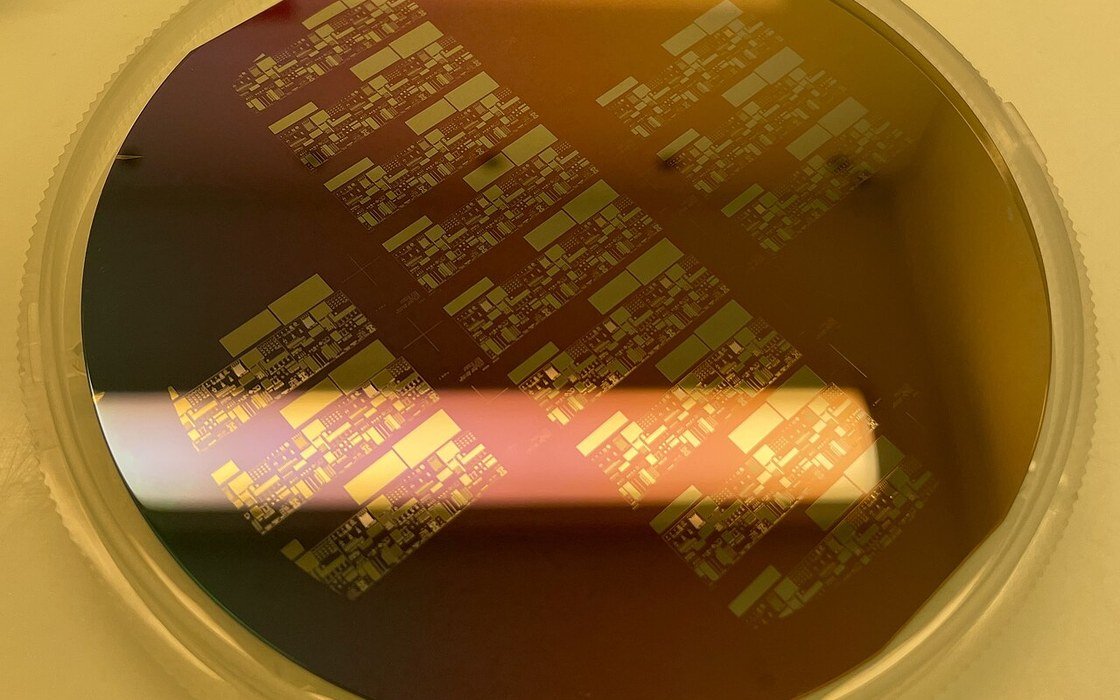
A university team has published a bio-hybrid memristor that stores and processes in the same place. The reported gain is one tenth of the power of comparable devices, with the cell still working at room temperature after six weeks.
A research team has built a working memory cell out of two materials that do not usually sit together. One is synthetic DNA, made from commercially available chemically engineered molecules arranged into short sequences cut to a chosen length and composition. The other is crystalline perovskite, a semiconductor already used in solar cells, lasers and data storage. The result is a memristor, a resistor that keeps a record of the current that has passed through it and remembers the direction of flow after the power is removed. The work has been published and a patent application has been filed.
The engineering step that made it work was doping. Silver nanoparticles were added to a layer of the customised DNA sequences, which was then integrated with thin films of perovskite. The silver let the DNA carry current and also pulled its molecular units into a more orderly arrangement. Short, rigid pieces of synthetic DNA can be positioned far more precisely at very small scales than natural DNA, which the team describes as behaving like wet spaghetti when handled.
Using just the DNA or just perovskite alone did not produce near as robust a result as the combination
Kavya S. Keremane, postdoctoral researcher in materials science and engineering and co-corresponding author
The numbers, and one the source disputes with itself
Electrons moved reliably at under 0.1 volt, against the 120 volts of a standard United States wall outlet. The device responded predictably when the direction of current was reversed. It kept operating at temperatures approaching 250 degrees Fahrenheit, which is about 121 degrees Celsius, and remained functional at room temperature for more than six weeks, which the team says exceeds the standard for existing perovskite based memory. On power, the announcement reports that the system performed the same memory function as comparable technologies while consuming one tenth as much. The same announcement also describes the saving as a hundredfold, in its title and in one quoted line. Those two statements are not reconcilable from the text, so the measured comparison against comparable devices is the figure carried here.
One gram of DNA holds roughly 215 million gigabytes. That storage density, rather than the switching voltage, is the reason the pairing is being pursued at all.
Why memory that computes is the point
Storing and processing in the same place is what separates this from a denser drive. Conventional machines move data between memory and processor, and that movement costs time and energy. A memristor array holds the state and operates on it where it sits, which is closer to the way neurons work and is the basis of neuromorphic designs. Systems built that way can weigh several inputs at once. The research group's argument is that neuromorphic hardware will be needed as artificial intelligence workloads grow, and that such hardware becomes costly and inefficient at scale unless the storage density rises and the power falls at the same time.
We can computationally determine exactly which sequences we need and how long they should be, and then we can rationally design them with synthetic DNA
Neela H. Yennawar, research professor and director of the Biomolecular Interactions Core Facility
What it is not yet
This is a laboratory device with a patent application behind it, not a product. Nothing in the announcement addresses yield, write endurance, read speed against current memory, or what any of it costs to make. The six week room temperature figure is a stability result on a research timescale and not a service life. The team says the next step is to improve the technology and look at other uses for bio-inspired electronics.
For anyone watching data centre power, that is the line worth holding on to. The energy bill of an artificial intelligence estate is set by hardware that has not yet been invented, and this is one attempt at it. It is a long way from a wafer in a laboratory to a rack in a shed outside Slough.